A while back, I saw a very good movie that documents the lives and plight of migrants who attempt to ride Mexican trains to aid in their cause to cross the border into the United States. The movie was called "Sin Nombre" and was a work of fiction based on real events.
Tonight, I saw the perfect companion piece to this movie. "Which Way Home" is a documentary -- nominated for an Academy Award in 2010 and directed by Rebecca Cammisa -- that follows a group of children ranging from 17 years old to as young as 9, if you can imagine, who face these unbelievable hardships and dangers of riding the trains to find a better life in America.
Whatever your politics are regarding immigration, they can and should be left at the door here, as there is no refuting the courageous and emotional journey these kids set out on -- nearly all of them either trying to reunite with their families already in the country, or to find jobs to help their families back home.
They leave notes for their mothers before they leave, and talk to them on borrowed cell phones on the tracks -- forced laughter keeping them from crying, as their mothers pray for them on the other end of the line. They light up when they are asked how they imagine the United States to be, and their answers are heartbreaking in their simpleness and naivete.
The most poignant of these comes from 9-year-olds Olga and Kenny, who come from Honduras. Olga, who hasn't seen her mother in three years, happily describes reuniting with her family in Minnesota and playing in the snow with her sisters -- before breaking into tears. They want to be doctors. We last see them walking away along the rails, dwarfed and enveloped as they merge with hundreds of their fellow travelers.
One aspect documented here that I was not aware of is the existence of Grupos Beta -- an organization formed by Mexican Immigration, which, rather than enforcing the law, provides water, medical aid and educates the migrants about the dangers they will face. In light of the illegalities and polarizing politics that frame this heinous underground world these people have chosen to travail, I found this example of genuine humanity to be impressive.
Young migrants ride 'The Beast.' (HBO)
Through all of this, I was -- and still am -- unable to comprehend that these are children, who are facing thirst and starvation, corrupt cops, being raped and left for dead by their own smugglers, some of whom are even hired by their parents ... and the train itself -- referred to as "The Beast" -- which regularly and viciously takes their lives.
"It tore him into three pieces," one kid says, remarking on a graphic newspaper photo showing the remains of a recent victim. "That's what happens when you fall on the rails."
Someone asks him, "So you're going back to Honduras then?"
"Nah, you're crazy man," he responds, laughing and without hesitation. "No, I'm not going back to Honduras."
Their parents are left to wonder where they are, if they're still alive, and to sign death certificates when they're not -- sometimes having to endure the wait of DNA releases because the bodies of their children are too decomposed to identify.
Earlier I mentioned the politics of immigration. This is a film that does not tread in that area but rather addresses the situations that may lead to the immigration problem in the first place. Are there things that can be done before illegal immigration becomes a last resort for these desperate people?
A director of a rest area, set up along the rails to allow traveling migrants a place to sleep, makes an empassioned speech, bordering on a plea, about the harsh realities that face every one of these travelers.
As he speaks, perhaps it is most important to reflect on how awful their lives must be back home that they are willing to risk all of these horrors -- to hear these words, and still have the unwavering determination to venture on ...
Mexico is the passage of death for you.
The freight train can be your best friend
because it will help you travel.
But it can also be your worst enemy.
It can kill you.
The United States is not the passage of death,
the United States is 'Death itself.'
At the border during the day, temperatures go from 120
up to 140 degrees.
And this jug (holding up a drum-sized container)
will not even last you for 3 days of traveling.
It is proven that at the border
out of every 100 migrants,
between 10 and 20, or more, will die.
Maybe many of you here will die.
Many of you will never see your families again.
Many of you here will never return to your countries.
There's nothing quite like the feeling when a movie comes along at exactly the right time to knock you over the head with its magnitude. I've had this one queued in the DVR for nearly a month, but I just got around to watching it tonight -- and I find it very interesting that I may very well have not been as receptive to it then as I am now.
I don't know if there's anything I can write that would do it justice, because I don't know if the movie is that good or if I just had a personal connection to it. Is this a recommendation? A tired, old so-called review? Some clumsy way to communicate something, but uncertain as to what that something is? I don't know. Some things don't really fit into a category.
The movie is "The Sunset Limited" and is an HBO adaptation of Cormac McCarthy's two-character play. The characters, named only "Black" and "White," are played by Samuel L. Jackson and Tommy Lee Jones (who also directed) -- I'll assume you can figure out who is playing who.
The entire play/movie is a conversation between the two and takes place in Black's dingy apartment in the New York ghetto, near a train station where White has just attempted to jump in front of a train (The Sunset Limited line specifically), and Black happened to be there to save his life.
Was it by chance that Black happened to be there? Was it divine intervention? Like the movie in its entirety, this is not clear, but the two begin an extraordinary and powerful discussion about humanity, the meaning behind our existence, faith, God and the afterlife.
Black is an ex-convict, who apparently has quite the personal relationship with Jesus -- and some pretty intense "jailhouse" stories -- while White is a college professor, hopelessly lost despite -- or perhaps more likely, because of -- his extensive education and finds the majority of Black's life-affirming, Bible-thumping diatribes to be exasperatingly nonsensical. But to casually label him as depressed or an atheist is to callously rob this character of the extraordinary depths of the anguish, darkness and emptiness that have driven him to this point.
Tommy Lee Jones and Samuel L. Jackson (HBO)
Here we must discuss the acting. Both are terrific, but Jones really stands out for me in this. Countering Jackson's upbeat, kind-hearted and optimistic outlook as his character remains nobly determined to help his guest see the light, Jones brings a tangible heaviness to his portrayal, a quiet and exhausted approach to the conversation behind dark eyes that are sunk deep into their bags. You know he hasn't slept for days. You know he's carried the burden he's carrying for years.
What clinched this movie for me is the shocking and unmistakable shift in both tone and power. For most of the film, Black is the dominant character. He's determined to save his guest's life, he's making him coffee, he's making him soup, he's initiating the entire discussion and he never wavers in his belief that he is right, he has God on his side, he is doing God's will and White will see the light.
But very quietly, darkness begins to take over, and the complete and utter despair that is inside White begins to emerge as he spews a chilling monologue that reveals his perception of the world and the futility of humanity. The use of lighting here is perfection and the words are frightening, the weight of which carries us to the end of the conversation, where we feel a palpable sense of transference, and we're witness to a poignant plea from one character that is undeniably relatable.
I found this movie to be a perfect adaptation of a dialogue-driven play -- where the theological conversation is truly compelling and the end is of the satisfyingly unsatisfying variety that I'm so fond of.
Most importantly, it's a movie where you need to hit the bar immediately after to discuss, because there are a myriad of questions, interpretations and feelings that can be derived from its content. Who is the one really being tested here? What if White is already dead? What does the apartment signify? Who's better off, the believer or the non-believer? Why is faith a good thing? Or perhaps most chilling, the thought that at first lurks in the background before slowly and deliberately enveloping you no matter how hard you try to suppress it:
How disconcerted are you that you relate most closely to White? ...
Surfacing in my DVR queue last night was PBS' season premiere of their American Masters series -- "Jeff Bridges: The Dude Abides."
We'll get to Jeff in a second, but I first have to say that this series does an amazing job. With this specific film directed by Gail Levin, the use of photography, behind-the-scenes material, clips from past movies, interviews with family, friends and colleagues and the way it is all seamlessly woven together with Jeff's own words makes for a highly enthralling 90 minutes.
Now, to Mr. Bridges ...
If ever there was someone who embodies the word "eclectic," it's Bridges. We can obviously see this in his body of filmwork -- the fact that he played the President of the United States in "The Contender" two years after playing The Dude in "The Big Lebowski" is all that needs to be said about this. And on that topic, one of the "grooviest" parts of this film, for me, is when he makes a surprise visit to a Big Lebowski tribute shop in Greenwich Village.
But the film also showcases his considerable talents off-screen, as a musician, photographer and painter. A few examples:
Bridges thought he would take the music route as a kid -- not wanting to go into his father's business right away -- and even wrote a song for the soundtrack of one of his brother Beau's early movies. Lately, Jeff said his role in "Crazy Heart" whetted his musical appetite, so he got a band together, had his agent set up some gigs, and he played at Niagara Falls for a couple of nights, thoroughly enjoying it.
He takes behind-the-scenes photos of virtually every movie he works on with a vintage Widelux camera, and makes albums as gifts for the people he works with on the movie. I happened to watch "Seabiscuit" a few nights ago, and there's a very poignant DVD extra featuring Bridges' camera shots that artistically illustrate the collaborative aspect of movie-making.
Bridges' talents as a painter and potter are also examined, as he's filmed intensively going to work with paints -- at one point spontaneously representing his family rising from white on a glass background -- and clay -- making a variety of pots and quirky resemblances of heads and faces -- all yet another outlet for his all-encompassing creativity.
Jeff Bridges and his vintage Widelux camera (PBS)
The film also examines Bridges' tendency to be hesitant or reticent in accepting virtually every movie or project that comes his way. He's one "who has to be dragged to the party," and confesses to having a bit of The Dude in him, an admitted laziness at times -- but once he's in, he's all in. It also brushes on his individual relationships with his family, which I found to be quite compelling and moving.
For me, when faced with immensely gifted people like this, who seem to be able to cram so much positive and beneficial work in their lives, it's incredibly inspiring to see all these gifts being used to their maximum potential. It also serves as a pretty jarring wakeup call -- an example of the way we should all get off our asses and live, to get as much as we can out of life by giving as much as we can.
One other thing I realized is how shameful it is that so many of his older films have escaped me. Not "King Kong," though! That flop earns the distinction of likely being the first Jeff Bridges movie I ever saw (and saw again and again for that matter), and -- more importantly -- very well could have led to his ability to explore more offbeat roles as his star appeal was briefly tarnished. Perhaps it is precisely his unassuming nature and propensity for unconventional roles that took me so long to get into his stuff, even though he was nominated for an Academy Award four times before winning with "Crazy Heart."
Consider a line spoken in this film by director Taylor Hackford: "We grew up thinking 'The Actors Studio.' You've got DeNiro, Pacino, Dustin, Brando ... you have all the method people in New York, and they really have the tap on great acting. Here's this guy in California who's this surfer dude. He's absolutely as good as any one of them."
So, yes, while I've seen many of his films by this point, I still have several on the must-see list to right this wrong. And with "Starman," "Cutter's Way," "Against All Odds" and "American Heart" all currently streaming live on Netflix, I'm envisioning a Jeff Bridges winter-day marathon in my near future.
********** Note: If you missed the program on TV, you can watch it in its entirety online here. Also, for an even more in-depth and intriguing look at his on- and off-screen endeavors, check out Jeff Bridges' official website.
"What do we live for, if it is not to make life less difficult for each other?" -- George Eliot (via Monica E. Smith)
It's a terrible thing to live in fear. But it's an entirely different thing to not only be unable to keep it private, but to have to face it on the global stage at a critical time in human history -- at which you are being looked to for leadership ... or weakness by your enemies.
This is the unenviable position Prince Albert (or "Bertie" and ultimately King George VI of England) finds himself in at the spectacular climax of "The King's Speech," and while we await what we know is coming, the journey to that point is incredible to watch.
Portrayed to perfection by Colin Firth, Bertie has been afflicted with a seemingly unconquerable stammer virtually all his life -- and after the death of his father, George V (Michael Gambon) and the abdication of his older brother, Edward VIII (Guy Pearce), the agonizingly reluctant Bertie accepts the crown, and does so when England is on the verge of declaring war on Germany, marking the dawn of WWII.
Let me just stop here to recognize Firth's performance, and to say that I can't imagine him not winning the Oscar for this role. From the opening minutes, when Bertie makes his heart-wrenching first speech at Wembley Stadium, Firth conveys every bit the fear, the embarrassment and the horror of being a regal figure with such an impediment, only to hear the mocking reverberations of his own stammer echoing throughout the stadium. Throughout the film, he displays a fully developed character, rich with emotions that also include humor, wit and charm, and we, too, are aware of the hours of preparation that were needed to master the evident technique that succeeds in portraying a realistic and not a hokey or exaggerated stutter.
Colin Firth and Helena Bonham Carter
But no great movie relies solely on one great character, and we have two outstanding supporting actors to ensure that this is also the case here. Helena Bonham Carter plays Bertie's supporting wife, Elizabeth, who is delightfully peculiar while demonstrating unequivocal love and sympathy for her husband's plight. She has seeked out specialists of all kinds to help her husband, and when none have panned out, she finds another.
This man is Lionel Logue (Geoffrey Rush), an Australian-born speech therapist who is also quite eccentric and offers his own unique brand of therapy to the short-tempered Bertie. What's critical here is that he's a "commoner," later we find him to be uncredentialed -- gasp! -- yet he's enlisted to help one who would be king. Lionel proves to Bertie early on that he may indeed be able to help, so the two proceed to have several very good scenes together, laying the foundation for what clearly is the beginning of a beautiful friendship. They work primarily, and colorfully, in Logue's drab home office, but proceed to a memorable sequence at Westminster Abbey as they rehearse for Bertie's coronation -- and Logue is with him to the end, when he delivers his speech that declares war and rallies his people behind him.
And what a flawless scene this is. I don't want to describe it fully, because the true experience lies in watching it play out, but with Elizabeth and Lionel by his side, Bertie's walk to the microphone is akin to one walking to his own execution; the microphone seemingly unveiled as an instrument of torture. And as he prepares to speak, and finally does, we're so emotionally invested in his journey to this point, the courage he's had to show, the myriad of agonizing challenges he's had to overcome -- combined with the support of his wife and the calming, silent coaching of Logue during this historic speech -- that I defy you to hold back your own emotion.
Colin Firth and Geoffrey Rush
This qualifies as one of the most inspiring films I've seen, and what continues to astonish me, is that it's another in a countless number of stories based on real life in which some of us seem to be chosen to live lives fraught with hardship, turmoil and quiet desperation. And it never ceases to amaze me that these people rise above it, when others (me!) would have given up ages ago, even as problem after problem mounts and countless setbacks are endured. Here, as prime minister Stanley Baldwin informs Bertie upon his coronation that he's resigning because of the impending war and then stoically tells him that "your greatest test ... is yet to come ..." you wonder how much more the guy can take as he stares blankly ahead, breathing deeply as he contemplates what he's going to have to go through, and that there's no way out.
What I like about this story specifically, is that it acknowledges that we all feel utterly alone at times with our own crosses to bear, our own unique hand that is dealt and our specific role to play. Yet, we are all human beings, equal in that aspect, trying to make our way in this world -- and how often the solutions to our problems seem to be in each other.
Here, a commoner uses his gifts to help a king, so that he, in turn, can fulfill his role. It provides the unmistakable sense that we are all connected, no matter the class system of the day, and that we are meant to freely ask our fellow man for a hand in our lives even as much as we are meant to offer our own.
Every new child born brings the message that God is not yet discouraged of man. ~Tagore
I'm not sure if I should be more baffled by missing this film from the standpoint of being a Bruce Springsteen fan or a fan of movies in general, but somehow, "The Indian Runner" -- which came out in 1991 -- completely escaped my radar until recently.
For one thing, it marks the directorial debut of Sean Penn, who also wrote the script, but perhaps more glaring, it is inspired by Springsteen's "Highway Patrolman," which is one of those tunes I can never skip in the iPod when it comes on.
One of the primary reasons I like Springsteen's music so much is because of the cinematic qualities that so many of them convey. And every time I listen to "Highway Patrolman," there are scenes so vivid I've actually thought that it would make a great movie someday.
And so it did ... or has! Like the song, "The Indian Runner" involves two brothers: Joe Roberts (David Morse), who is the deputy sheriff of a small town, and his brother Franky (Viggo Mortensen). The two are close, but have completely different personalities. Joe has the ability to enjoy the simple things in life: his wife, his child, his job, his garden. Franky has been a lost cause all his life, consistently in trouble with the law before fighting in Vietnam. Upon returning home he is still unable to shake his perplexing anger at the world that fuels his violent tendencies and troublesome nature.
The movie is identical to the song at the beginning and the end, but takes liberties with what the story may have been in the middle. For me, the plot isn't as important here as the characters, and this is what makes the movie work.
Morse and Mortensen are both excellent, inhabit their characters perfectly, and are -- very satisfyingly, I might add -- the epitome of the characters I picture when I hear the song. Surrounding them is their quietly suffering father, who is played to subtle perfection by Charles Bronson, and Franky's girlfriend Dorothy (Patrica Arquette), who is wide-eyed, innocent and possibly led astray by her own romantic perceptions while seeing something in Franky others do not. Joe's wife Maria (Valeria Golino) and a surprising, yet ultimately critical, cameo of sorts by Dennis Hopper also lend rich support to the story.
The movie bears similarities to two of my favorites. Like "The Deer Hunter," it is set in the gritty, blue collar, small town that only those who call it home can love, and it bears a strong resemblance to "A River Runs Through It," where the older brother, who appears to have his life together, battles his own insecurities while being forced to watch his younger brother destroy his life because he doesn't know how to help.
This is not a perfect movie, and is not quite up to par with these examples, primarily because of its pacing. At a run time of over two hours, it easily could have lost a half hour or so in the middle. It tends to meander a bit and, at points, uses a hammer to deliver its message instead of a nudge. And from a selfish standpoint, there is a line in the chorus of the song where the two brothers are out at a bar "taking turns dancing with Maria" that I really wish would have made it into the film!
But there are few perfect movies out there, and these are but a few minor issues I have with it. It's not an easy movie to watch -- it's bleak, it's sad, it's depressing, it's tragic -- but it perfectly captures the tone of this song that I like so much, sometimes with affecting poignancy, and that in itself makes it a worthy tribute and a commendable filmmaking effort.
Highway Patrolman
By Bruce Springsteen
My name is Joe Roberts I work for the state
I'm a sergeant out of Perrineville barracks number 8
I always done an honest job as honest as I could
I got a brother named Franky and Franky ain't no good
Now ever since we was young kids it's been the same come down
I get a call over the radio Franky's in trouble downtown
Well if it was any other man, I'd put him straight away
But when it's your brother sometimes you look the other way
Me and Franky laughin' and drinkin' nothin' feels better than blood on blood
Takin' turns dancin' with Maria as the band played "Night of the Johnstown Flood"
I catch him when he's strayin' like any brother would
Man turns his back on his family well he just ain't no good
Well Franky went in the army back in 1965 I got a farm deferment, settled down, took Maria for my wife
But them wheat prices kept on droppin' till it was like we were gettin' robbed
Franky came home in '68, and me, I took this job
Yea we're laughin' and drinkin' nothin' feels better than blood on blood
Takin' turns dancin' with Maria as the band played "Night of the Johnstown Flood"
I catch him when he's strayin', teach him how to walk that line
Man turns his back on his family he ain't no friend of mine
Well the night was like any other, I got a call 'bout quarter to nine
There was trouble in a roadhouse out on the Michigan line
There was a kid lyin' on the floor lookin' bad bleedin' hard from his head there was a girl cryin' at a table and it was Frank, they said
Well I went out and I jumped in my car and I hit the lights
Well I must of done one hundred and ten through Michigan county that night
It was out at the crossroads, down round Willow bank
Seen a Buick with Ohio plates behind the wheel was Frank
Well I chased him through them county roads till a sign said Canadian border five miles from here
I pulled over the side of the highway and watched his taillights disappear
Me and Franky laughin' and drinkin'
Nothin' feels better than blood on blood
Takin' turns dancin' with Maria as the band played "Night of the Johnstown Flood"
I catch him when he's strayin' like any brother would
Man turns his back on his family well he just ain't no good
"The Woman in the Window" has been on my list for a while, and I finally got around to watching it after having recorded it on TCM. And it did not disappoint!
Let me set the stage here.
Gotham College professor Richard Wanley (Edward G. Robinson) just kissed the wifey and kiddos goodbye as they left for a lengthy summer vacation, and he meets up with his buddies to kick off his freedom with dinner at the men's club.
Let me just stop right here and say these 1940's men's clubs are outstanding, and you can bet heavily that I'd be a regular. It's all so classy: Eating dinner and then adjourning to the lounge area for cigars, coffee and brandy in tall overstuffed chairs, surrounded by a library of books and hearths with roaring fires. I need to find these places.
But I digress ...
As Richard approaches the club, he notices an exquisitely painted portrait of a beautiful woman ... yes ... in a window, and is transfixed by it. His friends -- district attorney Frank Lalor (Raymond Massey) and Dr. Michael Barkstane (Edmund Breon) -- watch and chuckle as he stares at the portrait, and then give him some good-natured ribbing.
Later, after his friends have gone, Richard is awakened in one of those overstuffed chairs, as he was reading a book, with a glass of brandy (yes!) and makes his way out of the club. However, he's drawn to the painting once more, and as he's gazing at it, he sees the reflection of the very same woman in the glass. She is Alice Reed (Joan Bennett), and she's standing beside him on the sidewalk.
Having had a bit too much to drink, and fueled by conversations of being middle-aged and no longer being able to find the fun in adventure, Richard seizes the moment during the quite suggestive convo and agrees to accompany this captivating woman for more cocktails in the city and then a rendezvous at her apartment, where they are certainly enjoying themselves -- even though Richard knows better.
Alice:(Offering him a drink) Let's have another. Richard: I should say no, I know, but I haven't the slightest intention of saying it.
Inevitably, things go horribly awry. Alice's apparent boyfriend comes storming in, fights with Richard and, well, ends up dead. The two cook up a plan to cover it up, and it's here this thing shifts into another gear and becomes unrelenting suspense.
Joan Bennett and Edward G. Robinson
There are parts where it feels very Hitchcockian -- like a great scene in which Richard is driving and nearly runs an old-fashioned red light, and he looks out the window to see a cop smiling at his close call ... only Richard knows how close a call it was. There are lines spoken here or pieces of information dropped there that, when they occur, you know they will come into play again later. The whole movie and its complexities are structured so well, it's just a prime example of flawless storytelling.
The film is a perfect companion piece to "Double Indemnity," which Robinson is also in but has the pleasure of playing a character with considerably less stress and anxiety -- the friend who unsuspectingly closes in on his buddy who is trying to get away with murder.
Here, that part is played by Massey's agonizingly analytical district attorney, who expertly begins to put his theories and the case together right in front of his squirming friend.
Massey: Now these two people, this man and this woman, sit ... hating and fearing each other. Each wondering how long it'll be before the other is caught and blabs out the whole story.
It's fascinating to watch this old-school deductive reasoning and logic at play here, without the CSI-style, DNA-gathering techniques we're used to seeing today. And it's equally fascinating to watch Richard -- who, I have to say, for a college professor makes some colossal blunders -- marvel at the police's expertise, get stuck in these hilariously distressing situations, screw up, try to cover up again and continue to plot and scheme his way out of this mess.
And just when you think things can't get worse for Richard and Alice, a blackmailer is introduced in the sleazy form of Heidt (Dan Duryea), who makes things even more miserable -- in some intense scenes with Alice -- but he also thrusts this story into overdrive toward the riveting conclusion.
Now, the ending ... I'm sure for its time it was quite a riot, and yes I got a kick out of it. But watching it today, I would have gone another way with it -- bending toward the tragically ironic and more befitting of the elegant Hitchcockian track it was on.
But overall, this is an absolutely entertaining film, and if you sit back -- maybe with some frosty Guinnesses as I did -- and let it all play out, you'll enjoy this movie immensely whilst leaning forward on the edge of your seat throughout ... guaranteed.
If you keep going over the past, you're going to end up with a thousand pasts and no future.
At its surface, "The Secret In Their Eyes," which won Best Foreign Language Film (Argentina) at the 2010 Academy Awards, appears to be a police drama, but as the story evolves it becomes a mesmerizing film that spans two decades, with emotional intertwining themes and rich, fully developed characters.
The film begins in 1999, 25 years after the brutal rape and homicide of 23-year-old newlywed Liliana Coloto (Carla Quevedo) went unsolved, due mainly to a corrupt legal system. The criminal investigator, Benjamin Esposito (Ricardo Darin), now retired, is still haunted by the case and the events surrounding it and, to cope, is attempting to write a novel about it.
He reunites with Irene Hastings (Soledad Villamil), his former supervisor on the case and with whom he was (is?) in love, to present to her his idea and notes for the novel. She is affected by the case as well, and neither has talked about it until now.
From here, the movie follows a two-themed track as it flashes back to the mid-70's and the characters involved attempting to solve the case, and flashes forward as they attempt to live in its aftermath.
For one, it's a detective story that primarily involves Hastings, Esposito and his alcoholic assistant, Pablo Sandoval (Guillermo Francella), an affliction rendered even more tragic by revelations of his keen mind, along with his sense of humor and genuine affection for Esposito. For such a heavy drama, the two share some very good comedic and lighthearted moments.
The detective track also introduces us to Ricardo Morales, Liliana's grieving husband, who is played thoughtfully by Pablo Rago. He is devastated by Liliana's death, conveyed through some heartwrenching scenes, and goes to obsessive lengths to find the killer and avenge his wife.
When we are introduced to the primary suspect, Isidoro Gomez (Javier Godino), it is done in a breathtaking scene that takes place during a soccer game and is filmed in a fashion I've never seen before. Forget the fact that they find the guy in a jam-packed stadium, it is so uniquely shot and suspenseful that it is quite memorable.
Soledad Villamil and Ricardo Darin (Sony Pictures Classics)
Intertwined with the police story, the film is also a story of unspoken love between Irene and Benjamin, and how the inability to acknowledge their feelings for each other dooms them to lives they may not have been meant to live. As a result, they seem forever caught in the past, and their only future is to live with the notion of how things should have been.
What I really like about this film is how the two different tracks reflect the same themes. As the case is reopened, also reawakened are the unspoken feelings between Benjamin and Irene; as the case -- chillingly I might add -- addresses the issue of "How do you live a life full of nothing," Irene is forced to answer this question based on her life choices ... to mention just a couple.
The two tracks are also full of subtle parallels that I love: A typewriter with a missing "A" key, an "irresistible smile" that is initially unforthcoming, doors that are strategically left open or decidedly shut, photographs with eerie similarities ... each of these, and more, neatly apply to and are revisited in both the detective story and the love story at precise points.
The movie is graphic, but not gratuitously so, and at times, some plotlines are a stretch. But it's a movie, and thanks to some well-crafted scenes, including one of perceived self-sacrifice, and the actors' intricate performances set against a gorgeous soundtrack, the ride up to the film's climax is both riveting and dreamlike.
And what a thrill the climax is, as the story is peeled back layer by layer in a series of enthralling revelations, including a bone-chilling twist that is both jolting and, on a deeper level, a resounding sentiment of the perils in making the past the present and, subsequently, wiping out any chance at a future.
"That Evening Sun" is based on William Gay's story "I Hate to See That Evening Sun Go Down," and the screenplay was written by Scott Teems.
I want to get that front and center, because the writing in this movie is outstanding.
What was written? A story about Abner Meecham (Hal Holbrook), an elderly Tennessee farmer who begins the movie in a nursing home, talked into staying there by his attorney son, Paul (Walton Goggins). Clearly he's miserable, and clearly he won't be staying because he walks out and begins to trek back to his farm in the steamy southern heat, before an opportunistic taxi driver takes him the rest of the way.
Upon his arrival, Meecham finds that his son has rented the farm to the Choats -- Lonzo (Ray McKinnon), Ludie (Carrie Preston) and their 16-year-old daughter Pamela (Mia Wasikowska).
Meecham's not pleased.
So Meecham stays.
If we couldn't tell by the start of this film, we know now that Meecham is as stubborn as they come, and he simply refuses to give up his property that he spent a lifetime building -- especially to the Choats. He squats in an old tenant shack and plans to stay until they leave or are driven out.
Holbrook is exceptionally good here. His brief Oscar-nominated performance in "Into The Wild" was vivid, raw and memorable, and he certainly has accomplished the same with this character.
Meantime, Lonzo's none too happy about the old man making himself at home on his new property. He's introduced to us as a proper redneck -- showing up in a pickup truck that barely runs, long hair and beard in full force ... a six-pack in tow. He reminds me of Dwight Yoakam's Doyle in "Sling Blade."
Some of the greatest dialogue in this movie comes when these two get to childishly jawing at each other.
Meecham: (Watching Lonzo approach him from the house) You even walk like it. Lonzo: What's that? Meecham: White trash -- you even walk like it (laughs to himself). It amuses me. Lonzo: Must be great to be so funny. Meecham: Helps pass the time.
Then ...
Meecham: How do you expect to keep a farm this size when you can't even keep the lawn mowed? You're in over your head, son. Lonzo: Yeah, well we'll see about that ... stupid ol' coot. Hell, I'll just sit right here and outlive you, how bout that? (Takes a swig of beer). You're older than Moses anyhow, can't walk for sheeit, fallin' apart before my very eyes.
Hal Holbrook and Barry Corbin (Cooper Dunn/Dogwood Entertainment)
Clearly these guys need a voice of reason, and I found that to be in Meecham's neighbor, Thurl (Barry Corbin), who is excellent. We get some always appreciated old-man conversations between the two longtime friends, but they are interspersed with strategic glints of common sense Thurl throws at Meecham, who tends to be blind to it. Ludie also plays this part, if not moreso, having to talk sense into both Meecham and her husband, who are incapable of seeing what's coming down the road.
The fundamental problem here is that these guys are fighting over something that neither one of them can have. One thinks he can be a farmer, and the other thinks he can still be a farmer.
"That struggle gives them both purpose and also a distraction from the reality of their situation," says McKinnon.
As the movie progresses, however, a funny thing begins to happen -- we find ourselves thinking differently about these two guys than we did when we met them.
Initially, we root for the poor, helpless old man whose property was wrongfully taken away from him by the lazy, good-for-nothing, beer-swilling redneck. But curiously, we start to see that Meecham isn't all that good and Lonzo, while being terribly flawed and does some unspeakable things, is ruled by his own insecurities, anger and fear and is worthy of our sympathy.
This is subtly revealed to us in some very well-crafted scenes: An intimate talk between Lonzo and Ludie by the glow of the TV at night, and Meecham talking only to his dog -- who he adopted because it barked constantly and annoyed Lonzo -- about what put him in the nursing home and, more importantly, what made him leave.
And there's the scene where Meecham walks through his house alone again, playing an old familiar tune on the record player, reflecting on his late wife, seeing the haunting residue of pictures that once hung on the walls. We get the feeling he's not only mourning the loss of his house, but of his life overall ... getting a chilling glimpse of the way things are after we're gone and knowing that life goes on without you.
It sets the stage for a revealing conversation with his son, including:
Paul: There's nothing out there for you anymore, Dad. Things change. Life goes on. And you gotta go on with it. Meecham: Life goes on, huh? Paul: For those who let it. Meecham: I'm an 80-year-old man with a bum hip and a weak heart. How much life you think I got left to go on with? I'm no fool, Paul. The road ahead ain't long and it ain't winding. It's short and straight like a goddamn poisoned arrow! But it's all I got. And I deserve to do with it as I please.
Things inevitably escalate to some pretty grim proportions, including a grisly retaliation by Lonzo, on whom Meecham called the cops because of a drunken rage against his wife and daughter. We see Lonzo's retaliation coming a mile away, but we don't anticipate Meecham's response, which is sickly hilarious.
The ending I thought to be a bit ambiguous, especially after what we see silhouetted in a raging fire that nicely turns this story on its ear. From there, the film somewhat dissolves into a series of images, while I was expecting a little more closure.
But if we let them simmer, it's in those images that we can piece together the rest of the story, and reflect on the decidedly unambiguous messages the film itself may convey.
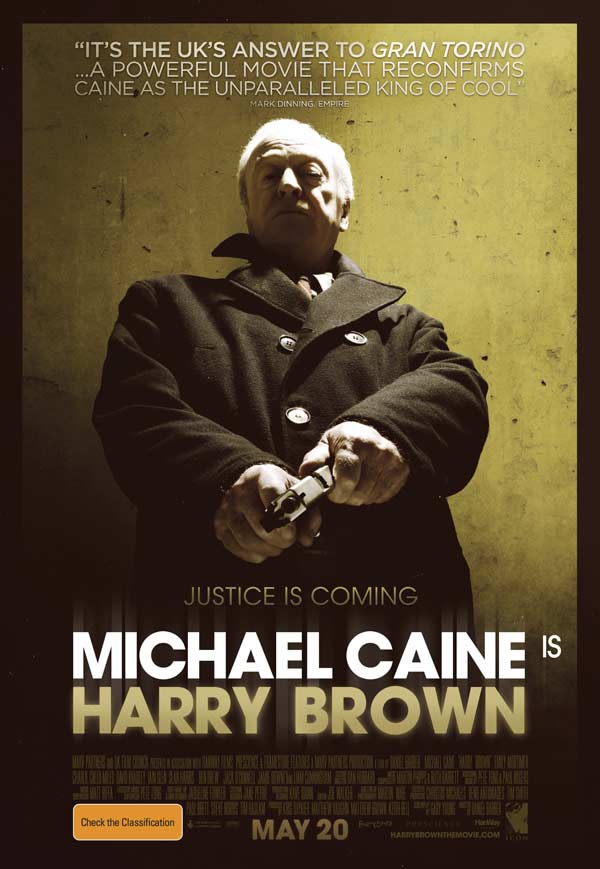
"Harry Brown" is a revenge story starring Michael Caine. It's gritty, it's disturbing and it's violent ... but there's a lot to like here.
The movie is set in the London projects -- or an estate, as it's referenced in the film. Drug gangs run the property, dealing in the open and terrorizing the tenants -- the opening scene is particularly terrifying and brutal. I wondered how a guy like Caine's character would be living in a place like this to begin with. The setting provides a perpetual state of loneliness, despair and the grim realities of life ... the sky is always overcast. Perhaps that tells us something about Harry.
Things are not going well for Harry. His wife is dying, his only friend, Leonard (David Bradley) -- with whom he plays chess over pints of ale in a dingy bar, a drafty old place where it seems like you always have to leave your coat on -- is being terrorized by the gangs at the estate, and he's revealed to Harry that he plans to do something about it.
He does, and it's not really spoiling anything to say that he fails, because this is the impetus for Harry's descent into vigilantism. There's a remarkable, and quiet, scene that involves Len's funeral. A procession of black cars with a hearse at the front, the word "Grandpa" painted on the window, approaches the place Len is to be buried ... and passes by, revealing only Harry standing at Len's grave, with a priest who is administering Len's final blessings. Heartbreaking.
From here, I found similarities to "Gran Torino" and "Get Carter," which Caine also starred in. Like Clint Eastwood in the former, Caine plays an elderly castoff who believes in the old-school way of doing things, and he has a fierce pride about him that conveys the fact that he can still do those things. The latter is also a revenge story, where Caine plays a contract killer taking revenge for the slaughter of his brother (Great trailer here!). But in "Harry Brown," Caine plays a character with more redemptive qualities and as a victim of his situation throughout, even though he calls on his experience from his younger days in the marines to take his bloody revenge.
There are some very good scenes here, including an unbelievably tense sequence where Harry goes to buy a gun from some despicable dealers. As he goes deeper into the bowels of this property, you feel as if he's creeping closer and closer to the bowels of hell. But as the scene unfolds, you can see Harry's character changing from being a helpless, tired old man to using his skills and tactical thinking forged in the military to handle this situation with viciousness ("You failed to maintain your weapon, son ..."), and then grace.
Emily Mortimer and Michael Caine (Dean Rogers/Samuel Goldwyn Films)
Along the way, Caine makes the acquaintance of a couple of inspectors, particularly the lead inspector, Alice Frampton (Emily Mortimer -- Very nice to see her again!). She's inquisitive and intelligent, but conveys tenderness and sympathy as she investigates Len's death and, subsequently, the relentless crime at the estate.
Ultimately, Harry's actions merge with the detectives' investigation and the rising violence of the estate, and everything escalates to frightening proportions. I felt the movie meandered a bit near the end, pulling away from Harry's story in favor of more of a commentary on the crime situation overall, but there's an interesting twist, a tense standoff, and a sufficient payoff to close things out.
What really makes this movie is Caine's performance. You can just put him in a scene, alone, with virtually nothing to do but put jam on his toast and get dressed for the day, and it will be enthralling. You never worry that he's going to wander too far on the dark side, because he conveys a strong sense of morality -- even if only on his face -- throughout.
The only thing I find worrisome is the immense satisfaction I get as Harry tears through this animalistic and subhuman culture, wielding his own brand of cold, hard justice.
I probably didn't need the opening notes of "The Promise" to let me know I'd like this documentary, but as it kicks off with the bare-bones chords of "The Promised Land" while a studio-fatigued Bruce Springsteen meticulously goes over each note, I undoubtedly knew I would.
This is an un-narrated documentary about the making of the album that followed up the smash hit "Born To Run," using both present and past interviews, studio footage and even some home movies thrown in. At its heart, it conveys the massive challenge it is to follow a hit album, along with Springsteen's obsessiveness and perfectionism that at times seems like a curse as well as a gift.
Like the album itself, the documentary is kind of an enigma. It's not disclosed whether the album was a success or not -- there were really no hit singles, although Rolling Stone ranked it #151 on its list of the 500 greatest albums of all time -- and it tends to deliver a sense of what this record MIGHT have sounded like, since it discusses the songs that didn't make it onto the record as much as, if not more than, the ones that did.
At its core, "Darkness" is about the heartland of America and the tough lives that are forged within it. It's clearly grittier, more stripped down and angrier compared to "Born To Run," but like that album, there's still that sense of hope lurking underneath.
"One of the elements that was so striking between 'Born to Run' and 'Darkness,' on 'Born to Run' you had the character saying, 'Baby we were born to run, we're gonna get out,'" says E Street Band drummer Max Weinberg. "In the ensuing three years between 'Born To Run' and 'Darkness' it was made painfully clear you can't just run away."
And so the documentary conveys the change in writing that this album brought about in Springsteen. He moved away from writing a pure rock and roll record and evolved into writing themes that are very cinematic in scope, dealing with loneliness, the hardened lives of blue-collar America and, as he puts it, "deep despair and resiliency." I always think of "Taxi Driver" or similar '70s movies when listening to the songs from this album, and guitarist/songwriter Steve Van Zandt makes a comparison to John Wayne in "The Searchers."
"It's a reckoning with the adult world, with a life of limitations and compromises," Springsteen says. "But also a life of resilience and commitment TO life, to the breath in your lungs -- how do I keep faith with those things, how do I honor those things?"
He goes on to say that "after 'Born to Run,' I wanted to write about life in the close confines of the small towns I grew up in. The success brought me an audience, but it also separated me from all the things I've been trying to make my connections to my whole life. And it frightened me because I understood what I had of value was at my core, and that core was rooted into the place I'd grown up, the people I'd known, the experiences I'd had."
This success was one "dark cloud" that was hanging over "Darkness." The other was a lawsuit between Springsteen and his former manager Mike Appel. Having signed himself over to Appel early in his career, he was essentially Appel's property and thus had to abide by certain requirements that prevented him from making his own decisions. It was a painful period, it cost him his friendship with Appel and significantly delayed the production of this album, leaving the fate of his band members in limbo.
"It was a lawsuit about control, who was going to be in control of my work and my work life," Springsteen explains. "Early on I decided that that was going to be me."
This very well could have been the impetus of this obsessive-compulsive nature we see from Springsteen. Throughout we are witness to his relentless writing and rewriting of songs with alternate verses/endings, and in one painful instance, spending weeks trying to capture the correct drum sound. What he heard in his head was unable to be accommodated by the studios of the day, which provided unnatural sound -- frustrating for a band that was trying to capture the sound of performing live.
But these painstaking processes also lead to some fascinating revelations. One involves the efforts to try to integrate the urban-sounding saxophone into an album with a rural focus. "Badlands," for example, initially didn't have that sax solo until they worked it out. Yikes ...
There's also a great segment regarding the song "Because the Night," the melody of which was written by Springsteen, who in turn gave it to Patty Smith because, being a love song, he says he was too "reticent" and "cowardly" at the time to finish it. Ultimately, it didn't mesh with the lone-wolf, unattached quality of the album, so Smith took it, made it her own, and it became her only hit song. (Cool to see Bruce "cover" his own song).
But we begin to see Springsteen's affinity for scrapping songs because they didn't fit the album start to take its toll. At one point we're told that with "Born to Run," roughly nine songs were written and eight made it to the album. On "Darkness," Springsteen had written, in various forms, an astounding 70 songs that were pared down to the 10 on the album. One of these was "The Promise," which to me sounds like it could be the flagship song of this album, but it was never finished because Springsteen "felt too close to it."
For a guy who says early in this documentary that he felt the need to "get everything you want to say out right now because you don't know if this will be the last record," this all feels very peculiar.
"It's really hard to write a good song," says Van Zandt. "For him to write good songs, possibly could've been hit songs, and to not put them out, put 'em aside, took an enormous amount of discipline and willpower. It's a bit tragic, in a way, cuz he would've been one of the greatest pop song writers of all time."
These words feel poignant when we see an absolutely outstanding rendition of Stevie and Bruce improvising the early stages of "Sherry Darling," which eventually made it to "The River." And I'm happy to say it resides on YouTube, so I encourage you to check this out here.
But what we clearly begin to see is that Springsteen had a vision for this record, and he didn't give in to the temptation to sacrifice that for something that may have brought immediate success but very well could have ultimately rung hollow in hindsight. And we take this to heart when the documentary finally gets to the point where Springsteen ruminates about the lyrics of a few of these tunes.
Darkness on the Edge of Town:Tonight I'll be on that hill 'cause I can't stop/I'll be on that hill with everything I got/Lives on the line where dreams are found and lost/I'll be there on time and I'll pay the cost.
These are the exulting words near the end of this song, obviously proclaiming the resiliency of the character in the face of despair, and Springsteen expands on it.
"It's not forsaking your inner life force, how do you hold onto those things, how do we keep those things, how do we do justice and honor those things?"
Factory: The paradox of earning a living that takes the life out of you. I always found this to be very compelling and haunting in a way, but never knew that it was inspired by his father, who lost his hearing at his factory job.
Racing in the Street: Another poignant ballad that asks how we carry our sins through life, but with a very cool anecdote here -- there was an early version that had no girl. If you listen to the lyrics, you'll wonder how that could ever have been the case. Springsteen shopped both around, including to Stevie, who advised, "Go with the one with the girl. That's what happens in life, two guys are pals, and the girl comes along, and that's it!" Classic.
As the film closes as it began, with the chords of "The Promised Land" being hammered out, Springsteen begins to discuss the lyrics behind this anthem as well. And as he does, he seamlessly evolves into discussing the theme of the album as a whole, a testament to his vision of including only the songs that perfectly fit within his desired framework.
"[It's a song about] your illusions of adult life and a life without limitation, which I think everyone dreams of and imagines at a certain point. The song that needs to be sung is the song about how do you deal with those things and how do you move on to a creative life, a spiritual life, a satisfying life and a life where you can just make your way through the day and sleep at night.
"That's what most of those songs were about."
**********
Rather than run the risk of feeling incomplete, it's important to note that this film should be regarded as part of the massive re-issuing of the "Darkness on the Edge of Town" album, coming out Nov. 16. It's a box set that includes the remastered album, never-before-seen studio footage and 21 unreleased songs, and much more. You can get all the details here.
I think we're more than past due for a James Bond write-up, don't you think?
And what better way to start than with the one that kicked them all off: "Dr. No." Believe it or not, I watched this for the first time tonight, and I really got a kick out of seeing how the franchise all began.
For one thing, as many times as we've heard the line in the myriad Bond films that have been made over the years, I challenge you not to crack a smile when you hear Sean Connery say it for the first time in his first-ever scene of the series -- at a card table, across from the mesmerizing Sylvia Trench (Eunice Gayson). It's perfectly delivered, with the signature look, cigarette included, and accompanied by the click of the cigarette lighter ... you relish it almost as much as he seems to, and it will never be uttered so well again.
Bond: I admire your courage, Miss ... Sylvia: Trench. Sylvia Trench. I admire your luck, Mr ...
I leave you to finish this exchange at your pleasure ...
Now, any bit of time we're able to spend with the lovely Ms. Gayson is something to be treasured. During their whole interaction at the card table and their provocative conversation afterward, she simply radiates appeal. You hate to leave her there as Bond makes his exit, and find yourself wondering when you're going to see this girl again.
Well ... again comes just a few scenes later, in one of the most glorious movie entrances you'll ever see. There's Bond, going back to his hotel room to prepare for his departure on assignment. He hears somebody in his room, takes his shoes off to sneak up to the door, draws his gun, flings the door open and ducks to one knee to prepare to fire ...
... and with Bond crouched to one knee in the background, Ms. Gayson's flawless legs frame the shot in the foreground as she misses a golf putt wearing just a nightshirt.
Sylvia: There ... you've gone and made me miss it ... Bond: You don't miss a thing ...
There's nothing more to say here. Except this:
I'm pretty sure we're all clear on the fact that plot is not a concern with these films. I mean, let's face it, Bond has to save the world from a supervillain hell-bent on ... yep, world domination. "The same old dream," as Bond says. So my favorite parts are the subtleties and nuances of Connery's performance or Bond's style in general.
I like when Bond is on his own. There's a scene here where he's in his hotel room in Jamaica about to leave for the day, and his meticulous preparations are enthralling to watch. He checks the outside door, closes it and locks it; he dusts the latches on his briefcase for easy detection of fingerprints; he walks to the closet, yanks a strand of hair from his head and places it across the crack in the door, so he'll know if someone opened it; he puts his shoulder holster on, slips his jacket on and walks out the door.
And when he comes back, he slips his jacket off, goes to the closet to find the hair is gone, goes to his briefcase and, with a knowing look, finds fingerprints on it; he pours himself a glass of vodka from the open bottle, thinks better of it, sniffs it, and opts for an unopened bottle instead. He goes back to his chair, puts his feet up and relaxes with his drink.
Little does he know that someone left a horrifying surprise for him, which wakes him up in the middle of the night in a paralyzingly intense scene!
Or take the sequence when he sets a trap for an anticipated intruder. He pours two drinks, sets them on the coffee table on opposite sides, strategically arranges the pillows on the couch, takes his jacket off and tosses it there. All the while he's smiling to himself as he crosses the room to the bedroom, flips on the record player and closes the bedroom door. He messes the sheets, slides a pillow under it to resemble someone sleeping, walks to the chair behind the door, loads his gun w/ a silencer and plays solitaire while he waits.
Of course, the trap works perfectly. Guy comes in and fires six shots at the bed, and ultimately meets his demise when he makes a move for his empty gun after Bond made him drop it: "That's a Smith & Wesson, and you've had your six," Bond says, cigarette dangling, before coldly dispatching him.
I also, naturally, admire Mr. Bond's ability to budget his time between saving the world and enjoying the lovely ladies. Shockingly, as he tracks Dr. No to an island called Crab Key, he makes the acquaintance of yet another. Enter the young, the tanned, the blonde, the beautiful Honey Ryder (Ursula Andress).
This girl killed me, because you have no idea what's going to come out of her mouth next. One minute she's young and innocent -- when Bond asks her if she'd ever been to school, she replies: "Didn't need to, we had an encyclopedia. I started at 'A' when I was 8 and now I reached 'T'. I bet I know a lot more things than you do."
And in the next breath, she matter-of-factly, and chillingly, discloses how she once disposed of a man who took advantage of her in the past, and Connery's reaction to this is priceless:
Honey: "I put a black widow spider underneath his mosquito net ... a female, they're the worst. It took him a whole week to die. (Looking pouty) Did I do wrong? Bond:(Stunned and looks away) Well, it wouldn't do to make a habit of it.
Now what other movie are you going to find these gems in?!
The film then becomes almost science fiction, as they do battle with a flame-spewing tank and find Dr. No's absolutely fantastic lair under the sea, along with his well-financed lab from which he will wreak havoc with the United States' space program. Bond and Honey are taken prisoner -- mind you, it's first-class lodgings -- which, of course, invites some witty repartee between Dr. No and Mr. Bond, especially when they notice Dr. No's spectacular fish tank that magnifies everything on the other side.
Dr. No: You were admiring my aquarium. Bond: Yes, it's quite impressive. Dr. No: A unique feat of engineering if I may say so, I designed it myself. The glass is convex, 10 inches thick, which accounts for the magnifying effect. Bond: Minnows pretending they're whales ... Just like you on this island, Dr. No. Dr. No: It depends, Mr. Bond, on which side of the glass you are.
From here, we're treated to a fairly standard Bond ending, where he's presented with a very convenient method of escape, takes care of business and gets into a death struggle with the criminal mastermind, who inevitably becomes a victim of his own creation.
And so Bond is triumphantly born ... as is the persistent question we will all ask ourselves in virtually every movie to follow in the franchise:
Why can't these elaborately scheming supervillains ever put their brilliant minds to something useful?
This is uttered during Part I of the "Red Riding Trilogy" -- a British TV series that centers on Yorkshire, England during the time of the Yorkshire Ripper serial murders that occurred during the 1970s. The line is brief, I don't believe it was ever said again throughout this 300-minute behemoth of a series, yet it seems to be the singular sentiment at the center of this story.
When I first started this blog, I subconsciously wanted it to be mainly positive, because there's enough negativity out there, and I made an unwritten rule not to publish complaints, grievances or rants of any kind -- if I don't like something, it won't make it to print.
But, tricky situation here, because I cannot say that I enjoyed this series overall. As it wore on, I started wanting it all to wrap up already so that I could leave this dark, insidious world and all of its despicable characters behind. But at the same time, I'm fascinated by how it was put together and the ambitious nature it took to tell this story.
The trilogy is divided into years 1974, 1980 and 1983. As each begins, it introduces the time period as "In the Year of our Lord:" which I found to be a nice touch, seeing as God is absolutely nowhere to be found in this story.
What I found interesting about this, though, is that while the entire trilogy is one written work, each part is driven by a different director with his own take on the subject matter. Further, you can tell that each part uses different cameras or type of film quality -- where 1974 is gritty and grainy, 1980 feels more cinematic in scope and 1983 almost appears to be in high-definition. It provides a realistic sense of time passing, as well as different interpretations of the characters, while perfectly capturing the essence of each segment.
Regarding the story, as the Yorkshire Ripper commits grisly murders after abducting, torturing and raping young girls and women -- subject matter that is unspeakably grotesque enough if it were the only heinous plot of a story -- the rotten to the core Yorkshire police department supposedly tries to solve the murders and capture the Ripper.
Problem is, they're so disgustingly wrapped up in their own egos, greed, lust for power and inhumanity to not only keep these murders from happening, but their horrifying acts are actually intertwined with the Ripper's murders. This effectively makes this whole world utterly deplorable and agonizing to be a part of.
I was hard-pressed to find any redeeming qualities from the vast majority of characters in this -- and those "good men" who do, in fact, try to do something are all flawed or carrying some sort of negative baggage, and they are systematically snuffed out for their efforts.
Even one cop, Maurice Jobson (David Morrissey), who has a so-called guilty conscience is a do-nothing, weak, spineless sap who watches, and participates, as all of these atrocities by the police department are set in motion. By the time he gets around to making a move, everything has devolved into a convoluted mess of sin, despair, knowingly wrongful convictions, preying on the innocent, torture of prisoners, malicious manipulation, and covering up the ghastly deeds of some of their own all in the name of ... what exactly? "To the North, where we do what we want," they toast themselves regularly.
Thing is, I really like Part 1. It surrounds a young journalist, Eddie Dunford (Andrew Garfield) eager to make a name for himself, and he gets a job as the crime reporter for the Yorkshire Post and takes it upon himself to find the Ripper and put a stop to the brutal slayings. He gets in too deep, becoming involved with the mother of one of the missing girls, and he becomes hopelessly entangled in the corruption. But his journey from being somewhat egotistical to genuinely wanting to prevent any more girls from dying is interesting to watch. I was hooked from the start, where thunder ominously rolls through a deep, heavy, gray sky accompanied by a haunting theme that plays throughout.
The second part is the slowest of the three, taking on a film noir style as a new detective -- Peter Hunter (Paddy Considine) -- six years later, is still trying to solve the murders, this time of prostitutes. Yes, he gets in too deep and becomes hopelessly entangled in the corruption. A memorable scene from this one involves the Ripper (Joseph Mawle) describing one of his kills that is utterly chilling, and unfortunately probably something I'll never get out of my head.
As the third part begins, you realize that nothing good can come of this story at all. Everyone is so completely appalling that it wears on you to the point where, while the film admirably tries to wrap up and connect all the parts together -- which does have its interesting moments that demonstrate the skill of the filmmakers -- you don't even care anymore. It all becomes a tangled web of twists and revelations that drowns out an obvious attempt at ending with an uplifting and redemptive moment.
Well, now that I have you running to Neflix to move this to the top of your queue ...
I understand I didn't sell this movie. I wasn't planning to. I think the majority of this diatribe is to clear my head from watching it. But as grim as movies like these are to sit through, sometimes I feel a kind of obligation to suffer through them.
Why? I'm not really sure.
What I'm mainly bothered by is that I'm not sure what the point of this movie is. I like to think it's saying that it's important to not completely disregard or turn a blind eye to the darkness of human nature, because it's then when we are at our most vulnerable.
But for two-thirds of this series, good fails miserably before earning some modicum of success -- and even then it cannot be celebrated because it carries with it the ugly scars of the past.
So we're really only left with one unappealing and downright frightening conclusion here ... that In the Year of Our Lord 1974, 1980 and 1983, in Yorkshire, the devil triumphs whether good men do something or naught.
************ Note: If you do check this out, I'd recommend putting on the subtitles. The accents are quite thick and the characters are very hard to understand, even though you'd rather not hear what's coming out of their mouths the majority of the time.
Very pleasantly surprised by "City Island," and equally baffled at how crazy quirky it is.
City Island is apparently a little-known location in the Bronx, about a mile long and a mile wide, which used to be a fishing village. It's quite quaint, with homes along the beach providing glorious views of Manhattan and housing families that have been there for generations. I gotta check this place out.
On this island resides The Rizzos, a family that definitely has some major issues. Headed by Vince (Andy Garcia), he's a 40-something prison guard who wants to be an actor. He sneaks cigarettes while reading Marlon Brando's biography by sticking his head out the window in the ceiling of the bathroom. He's too afraid -- embarrassed, thinks he's no good -- to tell his wife, Joyce (Juliana Margulies), so he tells her he has a poker game every time he sneaks off into the city to take acting classes. "Rather than tell your wife you're taking an acting class, you tell her you're out gambling instead? And that's better?" one character asks him.
Not to mention, while Vince is working a prison shift, he recognizes his long-lost son, Tony (Steven Strait), who is incarcerated. He hasn't told his family (or Tony) about this either. The prison releases a mystified Tony into Vince's custody, and he brings him home with him ... to City Island ... and his unsuspecting family.
These are just a few lies, or witholdings of truth, in a movie that is precariously full of them. Every member of this family has something off, a quirk, a fetish, a secret ... and everyone is too afraid to tell anyone else in their family about them, which, of course, creates larger problems ... and subsequent outrageous screaming matches in thick New Yawk accents.
Throughout the movie, and nicely offsetting the boorishness, is Jan A.P. Kaczmarek's lilting soundtrack. I've noticed his work in a few movies now ("Finding Neverland," "Hachi," "Get Low") and he's rapidly becoming one of my favorite film score composers ... The soundtracks are hard to describe, they're all very melodic but have this unique ability to sound lighthearted and somewhat haunting at the same time. And that's certainly an interesting combination for this movie.
The movie meanders at points -- I have absolutely no idea what the storyline regarding Vince's obnoxious youngest son Vinnie Jr. (Ezra Miller) and his feeding fetish for the fat woman who lives next door (Yes, I just said that) has to do with anything, I guess it's his kink -- but where it works is the story involving Vince and some special supporting cast members.
I love Vince's story. There's something very cool about sneaking off and taking the skycar into Manhattan to study acting in a darkened studio theater. Alan Arkin is perfect and hilarious as his acting teacher, who's no better off than his students and the millions of other hopeful actors in New York, and you can't help but laugh at his angst ... especially when he goes off on his irritation with all the extra, and unnecessary, "pauses" actors take ... paraphrasing:
Emily Mortimer, Andy Garcia and Alan Arkin (Phil Caruso/Anchor Bay)
"All of a sudden, Brando comes along and everyone says, 'Oh my God he's a genius, did you see him thinking?!' Anyone here see 'The Fugitive Kind?' Somebody asked Brando what his name is. He's gotta think about it. Why?! Why does he have to think about that, it takes him a half hour to get back to the guy! It's not acting ... it's not thinking ... it's just ... well, it's just bullshit!"
Oh my God that floored me, and I'm still cracking up now writing it. I had to watch that rant about three times.
In this class, Vince also meets Molly (Emily Mortimer), who I absolutely love in this. As acting partners, the two form a friendship and meet in the city over pie in late-night cafes, or drinks, as confidants, and she gently prompts him to reveal his secret about Tony. It should come as no surprise that she holds an emotional secret of her own.
It's at one of these meetings that she spots a casting call for a movie that fits Vince perfectly and encourages him to go on his first audition. And, for me, this is the greatest sequence in the movie.
The anxious and apprehensive Vince shows up to the audition -- which is calling for a tough, blue-collar character -- wearing a black suit and tie, and the look on his face revealing his rising panic as he discovers a line of actors (including his acting teacher!) all dressed in blue-collar attire stretching around the city block, is outstanding. "What are you coming from a funeral?" one guy asks him.
Vince also discovers the part is for a DeNiro/Scorsese movie. He just so happens to be among a handful picked out of the mile-long line to read in front of the camera for Scorsese's casting director, and this whole scene simply has everything ... hilarity (when he starts off doing an overblown -- and what looks to be painful -- Brando impression), awkwardness and eventually some serious drama and emotion. Garcia is incredibly strong in this movie, evidenced with no uncertainty by his performance here.
Emily Mortimer and Andy Garcia (Phil Caruso/Anchor Bay)
This sequence carries over into a scene at a sweet, swanky bar with a sheepish Vince -- who gets a phone call for a callback and is unable to grasp the magnitude of what that means -- and Molly, whose genuine happiness over Vince's incredibly good fortune really makes you (or at least me) genuinely love her. You can see almost everything about what kind of person this mysterious woman is written on her face throughout this scene.
But as expected, with an exasperated Tony front and center and utterly stupefied by the level of dysfunction he is witnessing, all the lying and hiding catches up to the Rizzo clan, sparked by his immersion into their family.
And fittingly, just as what we've witnessed up to this point, everything comes to a riotous and bizarre and funny and emotional climax that's quite entertaining and thoroughly satisfying to watch.